
Dynamic working environments require adaptable building services technology
Office buildings must offer employees a high level of comfort. However, they may only be used intensively for part of the week – mainly on weekdays and during the day. And it is precisely then that the demands on heating, ventilation, air conditioning and sanitary systems are particularly high. Awareness of energy use by the occupants may not be as important as in private homes. For example, windows might be left open while the heating is running. Ultimately, the operating costs are borne by the company.
The operator is responsible for ensuring efficient systems and economical operation. However, the pump systems used on site could be old, oversized and not running efficiently. The situation is exacerbated when system upgrade budgets are limited and there's uncertainty about energy price developments, while ESG criteria, EU taxonomy, and national regulations are increasing the pressure to act.
Around 40 per cent of office buildings in Europe were built before 1970 and are in need of energy-related renovation (source: Energy efficiency of the building stock in the EU). However, with the current rate of renovation at one percent, the European target of a three percent annual renovation rate is still not being met.
Anyone who wants to future‑proof the operation of office buildings in view of 2050 net‑zero targets must combine comfort, efficiency and cost-effectiveness. This is because, although offices only account for around five percent of building space, their energy requirements are around 1.5 to 2 times the average energy consumption of all buildings. (Source: European Building Stock Analysis by Eurac Research, Institute for Renewable Energy ebsa_web.pdf)

Contact us now
We support you with solutions that help you meaningfully upgrade your existing systems.
Contact our expertsA comprehensive approach – from analysis to ongoing operation
Office buildings may follow clear usage patterns: weekdays, during the day, with significantly reduced usage in the evenings and at weekends. Technical systems must be able to reflect these dynamics. Consistently aligning systems with actual demand creates the basis for economical operation – without compromising comfort or availability.

We view office buildings as an interconnected overall system and offer pumps and pump systems for all central areas – from heating, cooling and drinking water supply to drainage, wastewater disposal and firefighting water supply.
Intelligent control concepts such as Multi-Flow Adaptation enable precisely tailored interaction between feeder pumps and pumps in the adjacent heating loops of multi‑storey office buildings. This allows the necessary flow rates to be automatically adjusted to changing usage patterns, ensuring reliable and energy‑efficient operation across all floors.
Building automation is the key starting point in office buildings. The Wilo-Monitor is a useful addition to existing building management systems. It can be used to read, analyse and clearly display additional system‑specific data.
Our highlight applications for office buildings
Office buildings place special demands on technical systems: fluctuating usage, high comfort requirements, and a clear focus on operational reliability and resource-efficient use for the operator. Our solutions are designed precisely for this purpose.
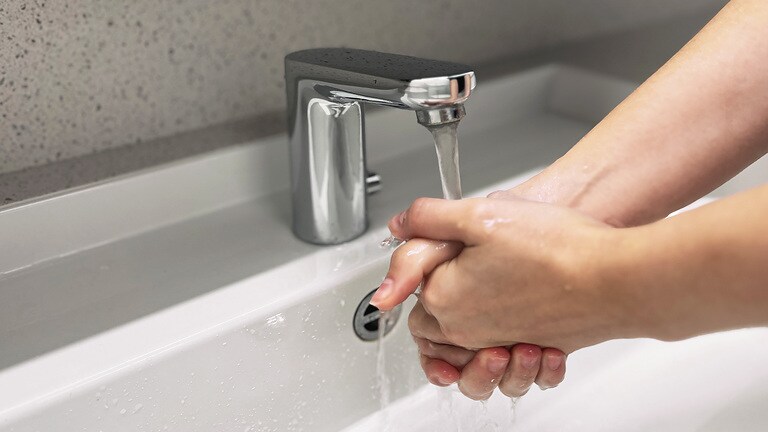
Water distribution and boosting
Availability at any time
In office buildings, usage and demand vary significantly throughout the day. In the morning, during breaks, or when occupancy is high, water must be available immediately at the right pressure. An intelligent pressure-boosting system ensures that comfort is guaranteed at all times.
- Constant water pressure with varying loads
- Reliable supply across all floors and units
- Adapted operation outside of busy office hours

Heating, ventilation, and air conditioning (HVAC)
Pleasant indoor climate – tailored to everyday office life
A comfortable working environment promotes concentration and productivity in the office. At the same time, weather conditions mean that heating and air conditioning requirements change constantly throughout the day and week. Modern, electronically controlled systems respond flexibly to these fluctuations and ensure that optimal working conditions prevail at all times.
- Precise adjustment of volume flows
- Efficient operation with demand-based use of energy
- Seamless integration into existing building management systems

Drinking water hygiene
Safety and consistent quality
During off-peak hours, on weekends, or on public holidays, stagnation can occur in drinking water pipes. Intelligent circulation systems ensure that drinking water keeps flowing, therefore preventing stagnation and ensuring high drinking water hygiene at all times.
- Central monitoring of water temperatures
- Domestic hot water circulation within the pipe network
- Water-saving, centralised and automated flushing procedures
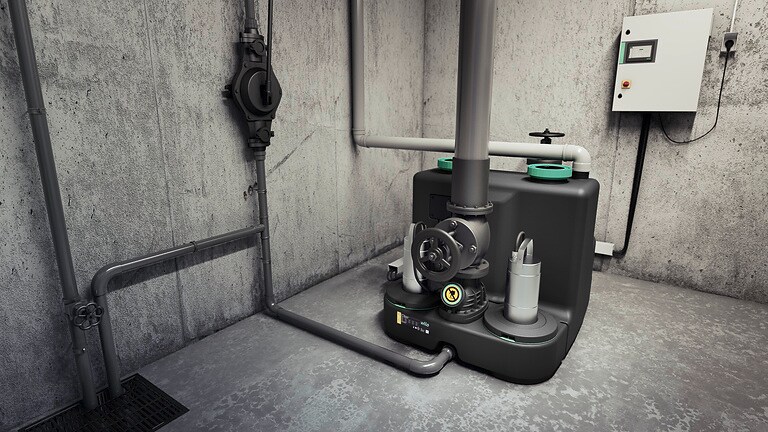
Wastewater collection and transport
Reliable drainage – regardless of usage and weather
During heavy rain periods or sudden downpours, the volume of water that hits properties, outdoor areas, and parking areas in a short period of time can be intense. These peaks must be safely and quickly drained away using powerful drainage systems. In contrast, the amount of wastewater generated in buildings depends on actual usage and fluctuates throughout the day and week. Robust systems ensure all types of wastewater are reliably transported away from the building.
- High operational reliability
- Designed for long-lasting, continuous operation
- Permanently safe removal of wastewater
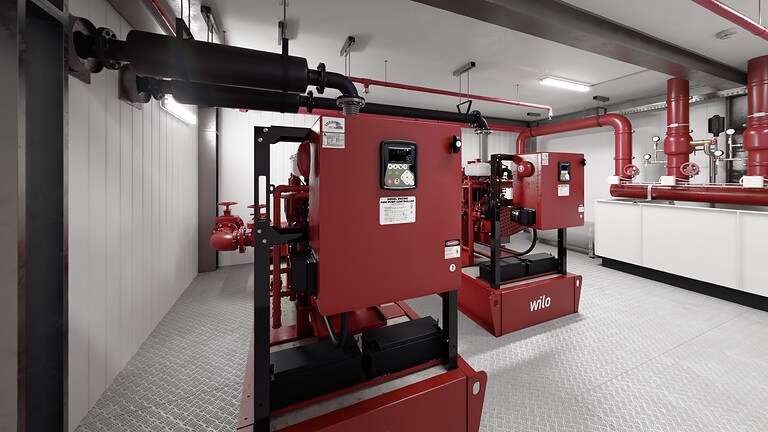
Firefighting
Protection for people, workplaces, and sensitive technology
In office buildings, the primary concern in the event of a fire is the safety of employees, followed by the protection of workplaces, IT infrastructure, and sensitive technology. A reliable fire-fighting system ensures that a quick and controlled response is possible in an emergency - integrated into the existing building services and tailored to the usage concept.
- Immediate availability in case of fire
- Reliable provision of pressure and volume flow
- Integration into existing security concepts

Rainwater utilisation
Using natural resources wisely
Valuable water accumulates on roof surfaces every day. Rainwater harvesting systems make this waster usable for building operations - for example, for toilet flushing or outdoor irrigation. This specifically reduces the demand for drinking water and lowers operating costs.
- Use of rainwater for toilets or irrigation of green spaces
- Reduction in drinking water requirements
- Integration into existing technology and usage concepts
Successful projects from across Europe
Our references show how office buildings, both existing and new builds, can be made economical and sustainable with modern pump and system technology - with measurable improvements in operation.

Staal-Kade office building in Amsterdam, Netherlands
A building steeped in history: designed in the 1960s by architect Arthur Staal, the building underwent extensive modernisation in 2023 and was awarded the BREEAM "Outstanding" certificate for sustainability as part of the renovation. A central element of the renovation was the integration of a rainwater utilisation system. It collects and performs treatment on rainwater, which is used in the building's operations for purposes such as flushing toilets.
Read More
This significantly reduces drinking water consumption and improves the building's ESG rating. The system is combined with a green roof that retains rainwater while also providing insulation and extending the service life of the roof structure. Additional filtration ensures that water quality remains consistent even in the presence of organic contaminants. In this way, an existing office building has been upgraded to meet future requirements - technically, functionally, and in line with today's standards.

DATEV Campus in Nuremberg, Germany
The DATEV IT campus in Nuremberg is one of the largest office and administrative locations of its kind in Germany. The campus covers a total area of around 100,000 square metres and combines modern working environments with a highly available technical infrastructure - designed for reliable operation around the clock.
Wilo implemented comprehensive solutions for the campus along the entire water cycle.
Read More
These include systems for heating, cooling, and air conditioning, as well as for drinking water supply, pressure boosting, drainage, and firefighting. All systems are designed for stable, demand-oriented operation and are integrated into the central building management system.
The combination of powerful system technology, intelligent control and a high level of redundancy ensures that comfort, operational reliability and availability are permanently guaranteed, even with fluctuating utilisation – a crucial factor for the smooth operation of a large office and IT site
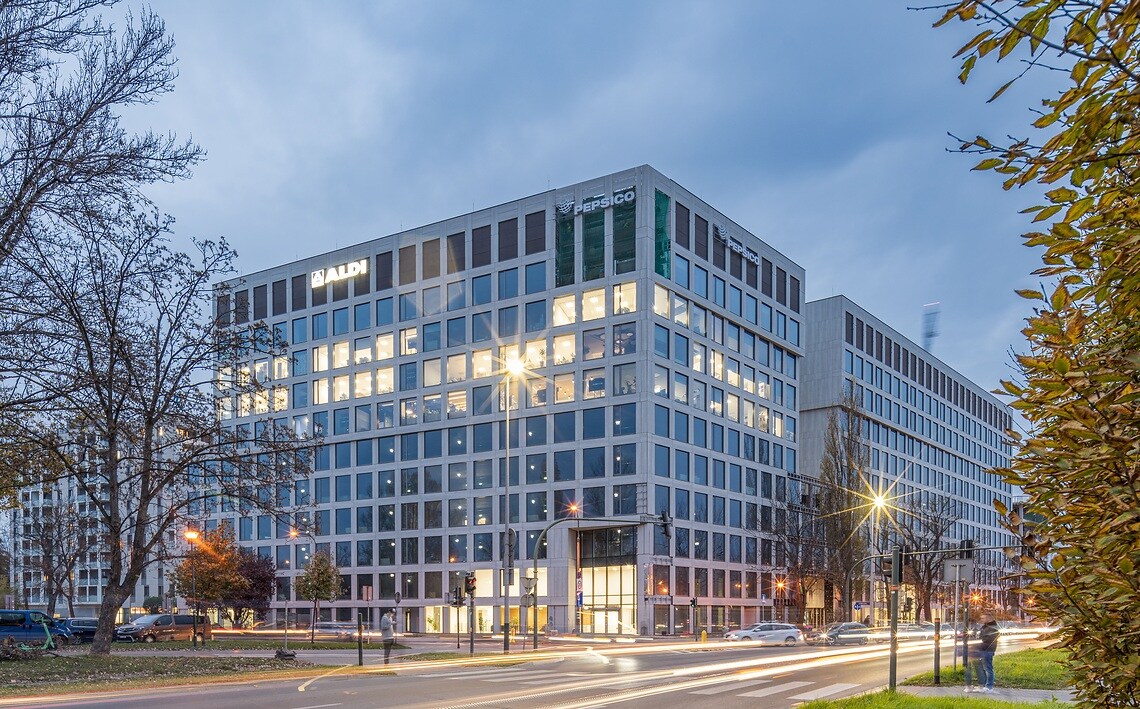
Brain Park office complex in Krakow, Poland
Brain Park is one of the largest office locations in Kraków. Its 10 above-ground floors offer 42,740 m² of office space as well as service and catering rooms. The architecture is designed for dense use, flexible space concepts, and high comfort requirements—with correspondingly complex demands on the technical building equipment.
High-performance pump systems were used for heating, cooling, drinking water distribution, and dewatering, which ensure stable operating conditions even when demand is simultaneous in several parts of the building.
Read More
The technology can be controlled centrally and allows precise adjustment to changing load profiles throughout the day and week. The result is an office complex that operates reliably even at high occupancy levels and is designed for economical, easily controllable operation – an important prerequisite for maintaining attractive office space in urban locations over the long term.
Customised service solutions for office buildings
The cost-effective operation of office buildings depends on reliable technology in the background. Our services support systems and equipment throughout their entire lifecycle - from commissioning to continuous optimisation.
Wilo-Energy Audit
Identify untapped energy saving potential and develop customised solutions for sustainable efficiency.

Digital solutions
Intelligently control pumps, network systems end to end, and make operating data visible – for greater transparency and control in plant operation.
Spaces for productive work
Office buildings are much more than just functional spaces. They are places where people work together, ideas are born, and value is created. When technical systems work reliably, quietly and in line with demand in the background, office rooms become spaces for concentration, productivity and well-being.
Our solutions help to develop office buildings responsibly - both existing buildings and new builds. They combine economic viability with future‑proof technology and put the people who use these working environments every day at the centre.

FAQ | Frequently asked questions about solutions for office buildings
How can existing office buildings be modernised efficiently?
Existing buildings offer great potential for optimisation, as technical systems are often outdated and their size and control systems are frequently not tailored to actual usage. Efficient modernisation begins with an analysis of existing pumps and system technology and focuses on targeted measures within the existing building stock.
This is achieved through improved system settings. Demand-based control, digital transparency, and the gradual advancement of existing technology can reduce operating costs, ensure comfort, and meet regulatory requirements - all with manageable investments. A complete replacement is not the goal and should only be considered as a last resort.
What role does monitoring play in the operation of office buildings?
Monitoring creates transparency regarding the actual operation of technical systems in office buildings. Operating states, running times, and anomalies become visible, enabling targeted optimisation. Monitoring helps identify inefficient operating modes, make maintenance easier to plan, and avoid malfunctions, particularly in existing buildings. This makes building operation more controllable and more economical in the long term.
Is optimisation possible even without an existing building management system?
Yes. Even if no building management system is available, pumps and pump systems can be monitored digitally. Our Wilo-Monitor solution enables the collection of relevant operating data, thereby creating the basis for data-driven operation.
This is particularly interesting for smaller or older office buildings that do not have a central building management system or when it is not intended to modernise such a system.
How can comfort and cost-effectiveness be combined in everyday office life?
In office buildings, usage and demand fluctuate significantly throughout the day and week. Technical systems that automatically adapt to these dynamics ensure a comfortable working environment exactly when it is needed.
At the same time, they avoid unnecessary loads outside office hours. This allows a pleasant indoor climate, reliable water supply, and economical operation to be connected in a sensible way.
What are the advantages of demand-driven pump systems in multi-storey office buildings?
Multi-storey office buildings place special demands on pressure conditions and flow rates. Demand-based pump systems automatically adjust their performance to current usage. To achieve this, the flow rates of feeder pumps and pumps for distribution to the various heating loops can be intelligently coordinated with one another via Multi-Flow Adaptation.
This ensures a stable and consistent supply on all floors and reduces energy consumption during operation.
How do digital solutions support compliance with regulatory requirements?
Digital transparency in system operation makes it easier to present energy consumption in a comprehensible way and to document optimisation measures. Monitoring and analysis tools help office buildings to better meet the requirements of ESG criteria, the EU Taxonomy and national regulations.
At the same time, they create a reliable data basis for investment decisions and the long-term development of the building.
Get in touch now and develop your office building for the future.
We support you from analysis to ongoing operation - with solutions tailored to your existing building.